Outcomes, Not Equipment
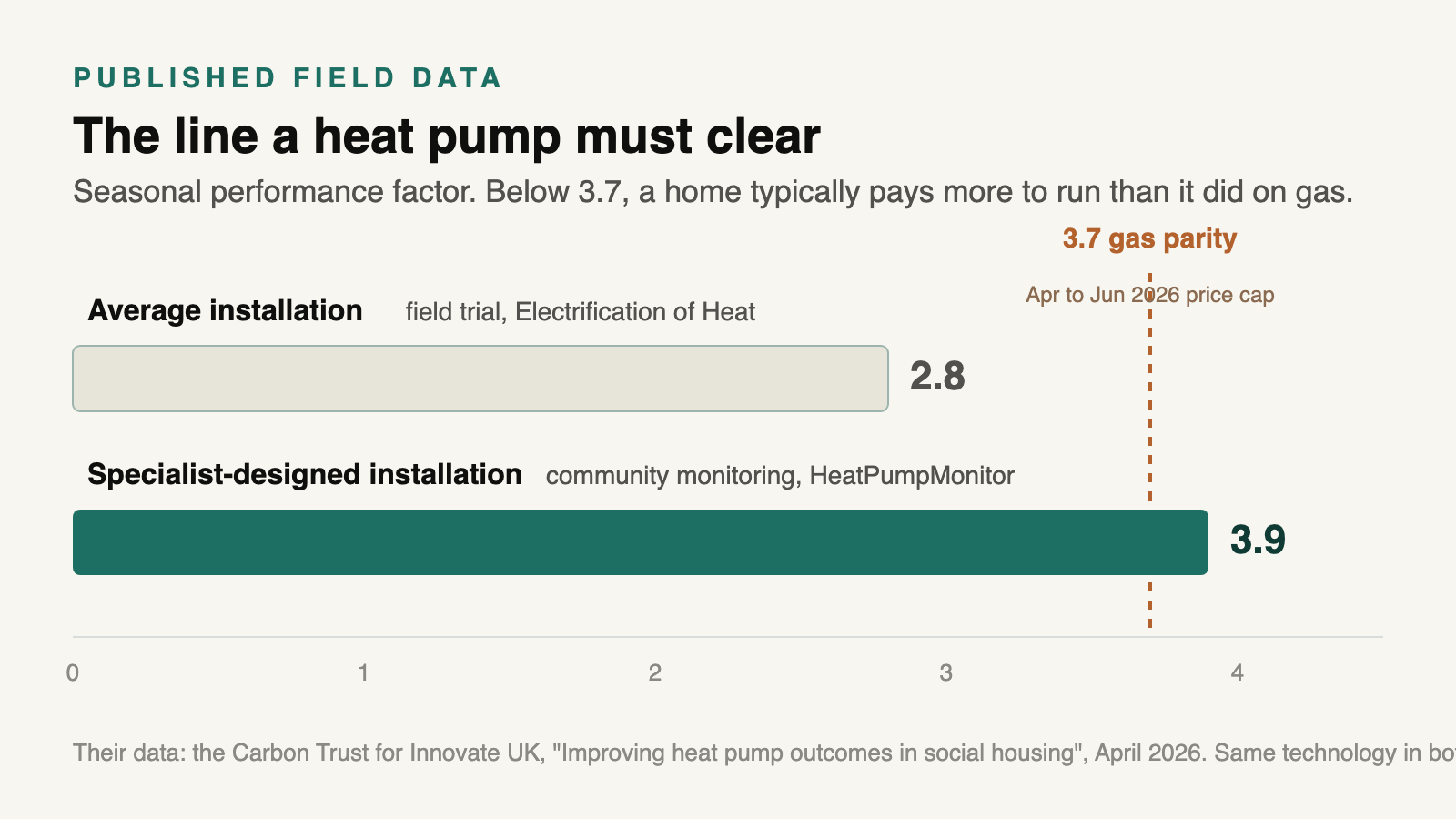
Three numbers decide the economics of every heat pump a social landlord installs, and this spring the sector's own institutions published all three in one guide. "Improving heat pump outcomes in social housing" was written by the Carbon Trust with Bristol City Council and the University of Bristol, delivered for Innovate UK's Net Zero Living Programme, and it is worth reading in full precisely because it comes from the sector rather than from anyone selling to it.
All three numbers are seasonal performance factors: the heat a system delivered over a year, divided by the electricity it took to deliver it. The first is 2.8, the median recorded across the Electrification of Heat demonstration project, the field trial often treated as indicative of average heat pump performance. The second is 3.9, the average from the community-led HeatPumpMonitor initiative, whose systems include a higher proportion designed by specialists in low-temperature heating. The third turns a spread into a verdict: on the April to June 2026 price cap rates, a heat pump typically needs to reach at least 3.7 to match or undercut the running cost of the gas boiler it replaced.
Read as fleet figures, the two datasets sit either side of that line, the field median below it and the specialist-designed cohort clear with room to spare, with the same technology in both. They differ in more than delivery quality, so the averages are better treated as a warning than a verdict. What they agree on is that delivery decides. For anyone running a decarbonisation programme the figures read as a housing outcome: the difference between a programme that lifts residents and one that, in the guide's own words, risks "deepening fuel poverty for the very households they are intended to help".
Where the spread comes from
We have written before about what the certificate never mentions: the same compressor technology and the same product lines appear at both ends of the performance spread. What varies is the work around the machine, which is to say how hot the water has to be before the radiators give up their heat, whether the system was sized against the heat the home actually loses, whether the controls that ease it through mild weather were ever set up. The new guide arrives at the same place from the sector's side, and finds that programmes which check quality across the whole journey, from design review through to monitoring after installation, catch underperformance early. Where those checks are missing, the underperformance surfaces later, in residents' bills.
What the guidance asks landlords to do
The central recommendation is a change in how landlords buy. Specify performance outcomes rather than equipment alone, require evidence of how an installer's past work performed, check quality at every stage, and monitor once the job is done.
That advice is right, and it carries a quiet test inside it. Could you state today, home by home, the number each heat pump in your programme should reach this winter, and at the end of the season show which homes met it?
For almost every programme in the country the plain answer is not yet, and not for want of trying. "At least 3.7" is not a property of a product; it is a prediction about a particular heat pump in a particular home over a particular winter. Stating the number means working it out for that home. Holding a programme to it means comparing what happened against what was expected, home by home, with a named reason wherever the two part company: a setting left at its factory default, a system sized for a different house, a control that was never switched on.
That is what programme assurance does, on the record HeatAssure keeps for each home, outside the delivery chain it reports on: an expected figure stated for every home in advance, the season's delivery set against it wherever measurement exists, and a plain statement of which homes carry measured evidence and which do not yet. Where the two diverge, the cause is named on the evidence, and where the work was right, the installer is cleared as plainly as any shortfall is explained. Which homes cleared the line, which fell short and why, in time to fix rather than years into anyone's bills.
The sector has written its instruction: buy outcomes, and verify them. What is left to settle is whether you can answer for them, home by home, before a board, a regulator or a resident asks it of you.
If the winter question is yours to answer: name a place, and we will show you what the public record already says about it. A first look, at no cost, with nothing needed from you to start: start with one place.
Sources: "Improving heat pump outcomes in social housing: a practical action guide", the Carbon Trust for Innovate UK's Net Zero Living Programme, April 2026.