Utilities are moving from energy supply into active home energy orchestration. Heat pumps, batteries, solar inverters, EV chargers, smart meters, smart thermostats, and time of use tariffs are becoming part of coordinated customer programmes rather than isolated devices.
That creates a new operating problem. Connectivity platforms can retrieve device data and send control instructions. Enterprise systems can manage customers, billing, service cases, programme eligibility, and reporting. But neither layer is designed to prove that a connected home programme is working as intended across thousands or millions of homes.
The missing layer is connected home programme assurance.
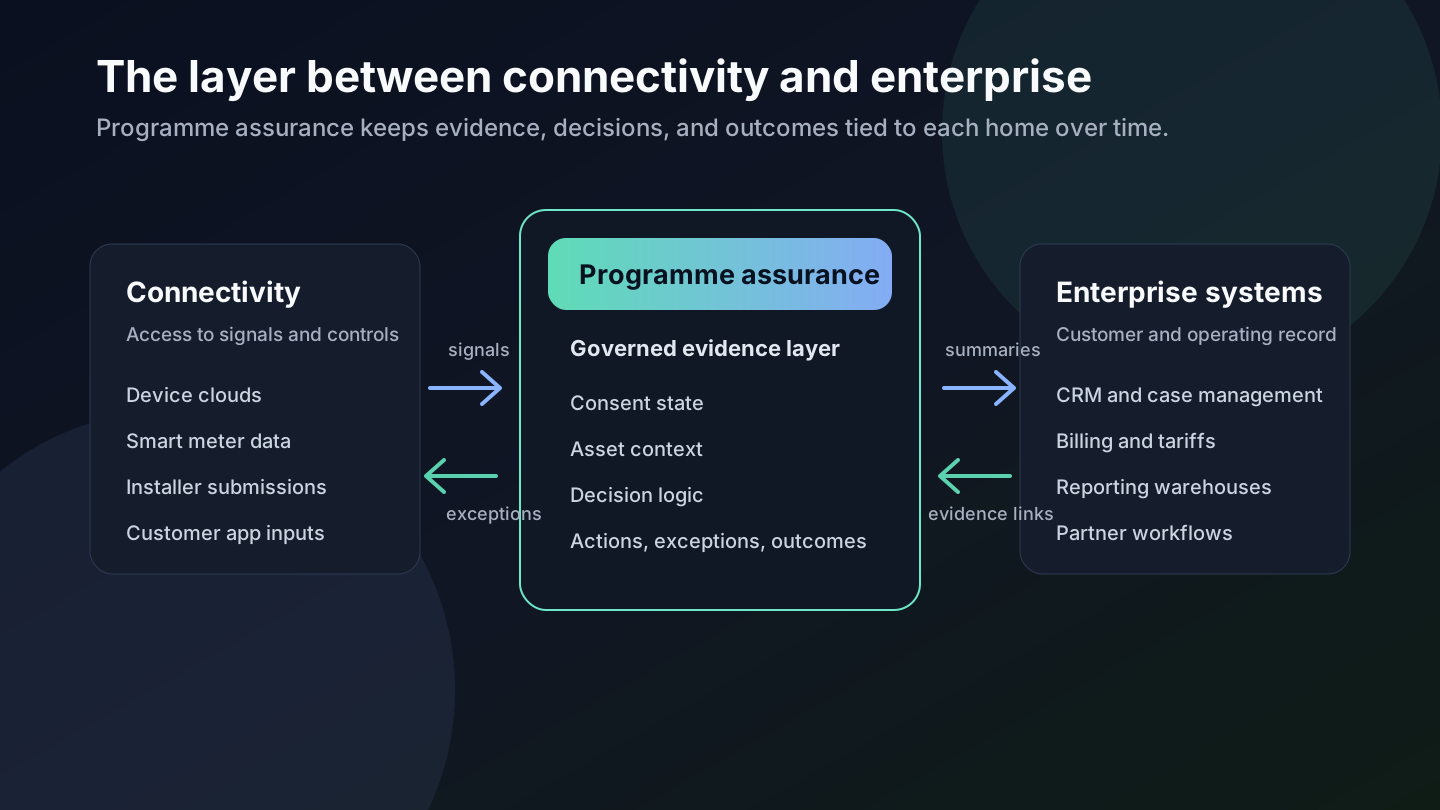
Programme assurance is the governed record between connectivity and enterprise systems. It keeps consent, asset context, decision logic, intervention history, exceptions, and measured outcomes attached to the same home over time. Without that layer, a utility may know that a home is connected and may know that a customer is enrolled, but it cannot reliably explain what decisions were made, why they were made, what evidence supported them, and whether the promised customer or system outcome was delivered.
Connectivity is necessary, but incomplete
Connectivity solves an important part of the problem: access. It establishes whether a device can be reached, what telemetry is available, and what commands can be issued. That is foundational for any smart tariff, flexibility, retrofit, or low carbon heating programme.
But access is not assurance.
A connected heat pump can report flow temperature, operating state, energy use, and fault codes. That does not prove that it was commissioned correctly, that it is suitable for a vulnerable household, that its operation aligns with the customer's tariff, or that a service intervention improved performance. A connected battery can respond to dispatch. That does not prove that the dispatch respected customer settings, maintained comfort, preserved consent, or produced the outcome claimed in a flexibility report.
Connectivity creates the signal. Programme assurance makes the signal usable for accountable operations.
Enterprise systems are necessary, but not enough
Enterprise systems hold the commercial and customer record. They know who the customer is, which products they have, what tariff they are on, what communications have been sent, which service cases are open, and which programme they have joined.
That record is essential, but it is not a technical evidence trail. Enterprise systems are rarely designed to maintain a live model of the home's energy assets, preserve device level context, version decision rules, or compare predicted and observed performance after an intervention. When connected home data is pushed directly into those systems, the detail is often flattened into notes, flags, events, or summary fields.
The result is a gap between operational reality and enterprise memory. The programme continues, but the reasoning behind it becomes hard to reconstruct.
What programme assurance does
Programme assurance maintains the evidence chain that neither side can hold on its own. It should answer five operational questions for every participating home:
- What is installed, connected, consented, and reliable enough to use?
- What baseline was used to judge performance or eligibility?
- What decision was made, by which rule or model, using which evidence?
- What action followed, and was it automated, approved, overridden, or escalated?
- What changed afterwards, and can the outcome be verified?
This is not a dashboard requirement. A dashboard can show that a device is offline, that a tariff event occurred, or that an exception queue is growing. Programme assurance records the chain from input to decision to action to outcome, so that programme teams, customer operations, technical assurance, and compliance teams can inspect the same governed record from different viewpoints.
The reference architecture
A vendor neutral connected home assurance architecture usually needs five layers.
The first is the connectivity layer: device cloud integrations, smart meter data access, installer submissions, customer app inputs, and field service updates. This layer should remain replaceable. Programme assurance should not depend on a single integration route or a single device category.
The second is the home asset model: a maintained representation of the home's fabric, heating system, controllable assets, tariff context, occupancy assumptions, vulnerability flags where appropriate, and consent state. This model is what allows raw telemetry to be interpreted rather than merely collected.
The third is the assurance ledger: a structured record of data quality, model versions, decision rules, recommendations, control actions, exceptions, overrides, and outcomes. The ledger does not need to be exposed to every user, but it must exist as the authoritative evidence trail.
The fourth is the programme workflow layer: triage queues, eligibility checks, commissioning checks, service escalation, customer contact, partner handoff, exception management, and outcome verification. This is where assurance becomes operational rather than archival.
The fifth is enterprise integration: customer records, billing, case management, field service systems, data warehouses, regulatory reporting, and partner reporting. Enterprise systems should receive clean, governed summaries with links back to the underlying evidence, rather than becoming the place where technical context is compressed beyond recovery.
Why utilities need this layer now
Connected home programmes are becoming harder to operate because they combine multiple forms of risk.
There is technical risk: device availability, telemetry quality, integration changes, control latency, and inconsistent asset metadata. There is customer risk: comfort, bill impact, consent, vulnerable customer handling, complaints, and opt out behaviour. There is commercial risk: benefit claims, partner performance, subsidy evidence, flexibility revenues, and installation quality. There is compliance risk: automated decision explainability, customer communications, auditability, and data minimisation.
Each risk is manageable when handled separately. The challenge is that connected home programmes combine them in the same household. A single control action may depend on device data, tariff logic, weather, occupancy assumptions, customer consent, grid signals, and programme rules. If the evidence chain breaks, the utility is left with fragments: a command log in one place, a customer note in another, and a reporting metric somewhere else.
Programme assurance keeps those fragments connected.
Design principles
Good programme assurance is not just more data storage. It needs clear design principles.
Consent should be treated as an operational dependency, not a static checkbox. If the scope of consent changes, the system should know which decisions and actions remain permitted.
Asset context should be versioned. A home with a newly installed heat pump, changed tariff, added battery, or updated control setting is not the same operating case as it was last month.
Decision logic should be traceable. Whether the action came from a rule, optimisation routine, forecast, or human operator, the record should show the evidence used and the reason for the decision.
Exceptions should be first class workflow objects. Missing telemetry, inconsistent device state, repeated opt outs, failed dispatch, suspected poor commissioning, and customer complaints all need ownership, service levels, and closure evidence.
Outcomes should be measured against the promise made. A flexibility event, retrofit programme, tariff optimisation, or low carbon heating deployment should be evaluated against the customer and programme outcomes it was meant to deliver, not only against whether a control signal was sent.
What this changes operationally
With programme assurance in place, a utility can scale connected home activity without losing the evidence needed to manage it.
A customer operations team can see why a home was contacted, what the system observed, and what options were available before a recommendation was made. A technical team can distinguish poor telemetry from poor equipment performance. A programme manager can identify whether failures are concentrated by device type, installer cohort, housing archetype, tariff design, or data quality issue. A compliance team can inspect automated decisions without reconstructing them from disconnected logs.
This also improves partner management. Connected home programmes often involve installers, device manufacturers, aggregators, local delivery partners, and public sector stakeholders. Assurance creates a shared record of what happened and what was evidenced, without forcing every party into the same enterprise system.
A practical starting point
Utilities do not need to replace their connectivity or enterprise systems to add programme assurance. The practical starting point is to define the minimum governed record for a participating home:
- enrolled customer and active consent state
- installed assets and confidence in asset metadata
- connectivity status and telemetry freshness
- applicable programme rules and model version
- baseline used for eligibility or performance comparison
- decisions made and actions taken
- exceptions, overrides, and service handoffs
- measured outcomes and confidence level
Once that record exists, the organisation can decide which teams need which view of it. Customer operations may need concise explanations. Technical assurance may need telemetry and model detail. Programme leadership may need portfolio level risk and outcome reporting. Compliance may need decision lineage and audit export. The underlying record should remain the same.
The strategic point
Connected home scale will not be won by connectivity alone. It will be won by the organisations that can operate connected homes as accountable programmes: technically reliable, safe for customers, commercially measurable, and auditable.
The assurance layer is what makes that possible. It sits between device connectivity and enterprise systems, not as another dashboard, but as the governed continuity layer that keeps the programme's evidence intact.
For utilities, that is the difference between having connected assets and having connected home operations they can stand behind.
Related reading
- What Is Governed Intelligence?: the decision architecture behind auditable evidence trails
- The Same Problem, Three Times Over: why continuity matters across buildings, heat pumps, and home energy
- Programme Assurance: the Home Energy Intelligence module for expected versus observed programme operation
- Programme Assurance proof: why assurance is the cleanest first proof path before broader optimisation